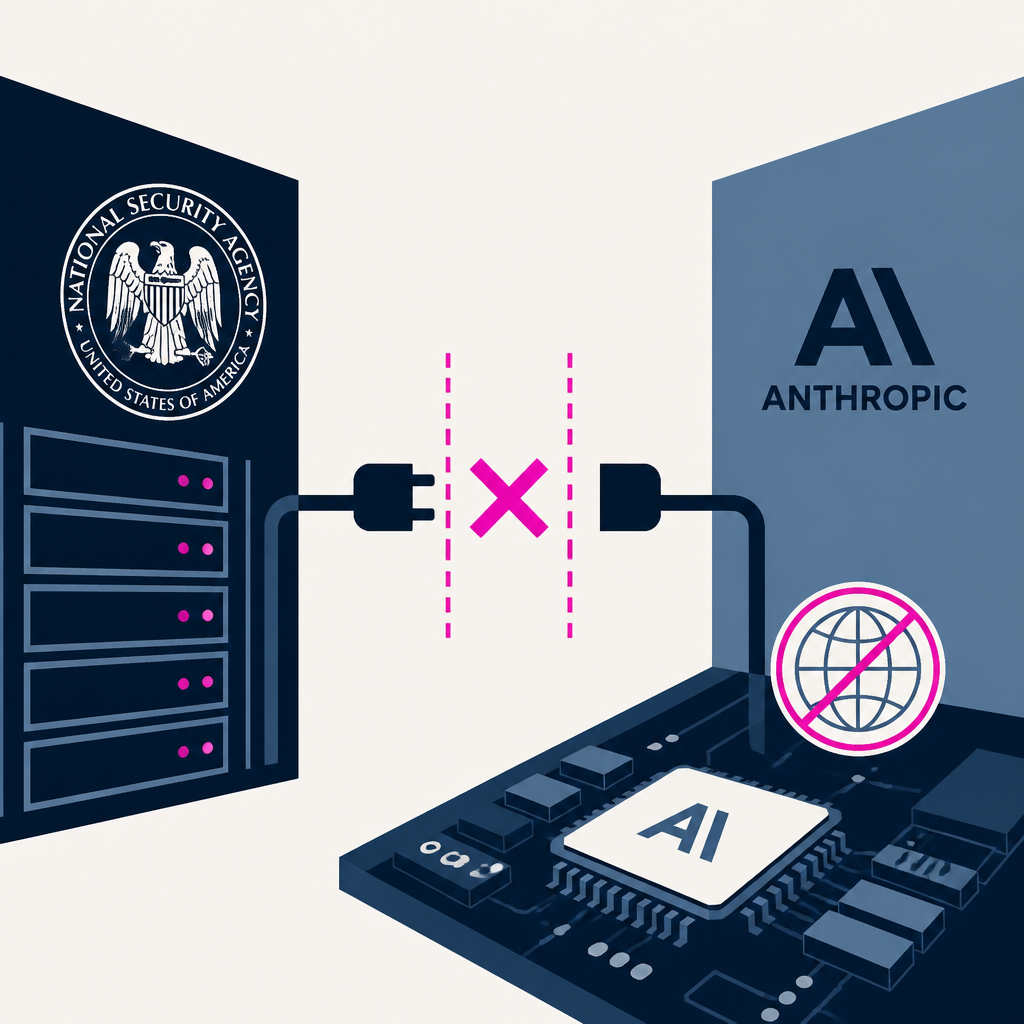
Anthropic's Pentagon Relationship Breakdown Over Guardrails
The Wall Street Journal
Leaked emails show Anthropic and the Pentagon hit a wall over what its AI can actually be used for. Turns out safety pledges and defense contracts don't mix easily.
Based on reporting by The Wall Street Journal — read the original for the full story.
Summary, retelling and take written by AI under human oversight; images are AI-generated illustrations. How we work · Report an error
There's a version of the AI-meets-military story that reads like a clean partnership: a lab builds smart tools, the government buys them, everyone nods about responsible use. The emails now circulating about Anthropic's relationship with the Pentagon tell a messier one. What comes through is friction, not synergy, over three things: how tightly Claude's guardrails should be enforced, how much access military users should get to the underlying models, and where exactly the line sits between defensive support and direct war-fighting use.
Anthropic has built its identity around usage policies that explicitly restrict weapons development and certain military applications, and that stance doesn't disappear just because the customer wears a uniform. The correspondence suggests Pentagon officials pushed for looser restrictions or faster paths around them, arguing that mission needs don't always fit neatly into a commercial terms-of-service document. Anthropic, for its part, seems to have pushed back, unwilling to hand over unrestricted access just because the buyer is the largest defense budget on the planet.
Access was its own sticking point. Military customers reportedly wanted deeper integration and quicker deployment timelines than Anthropic's internal review processes allow, which is a familiar clash whenever a safety-conscious lab tries to operate at government speed. The Pentagon isn't known for patience, and Anthropic isn't known for skipping steps, so something had to give — and the emails indicate neither side gave much.
This isn't happening in a vacuum. Every major AI company with any ambition toward federal contracts has had to figure out how much of its public safety branding survives contact with a defense customer. Anthropic marketed itself as the safety-first alternative to OpenAI and Google, so a public unraveling with the Pentagon lands harder than it would for a company that never made those promises in the first place.
What the leak really exposes is a structural tension nobody's solved yet: labs want defense dollars without diluting their safety commitments, and the Pentagon wants capable AI without slowing down for anyone's ethics review. Splitting that difference cleanly may not be possible, and Anthropic's bruised relationship with its biggest potential government customer looks like an early data point on just how hard that negotiation actually is.
My take — AI-written commentary, not fact-checked reporting
I don't think this is really about guardrails at all — it's about what happens when a company's safety branding meets a customer that doesn't care about branding, it cares about capability. Anthropic gets credit for not immediately folding, but let's not pretend any AI lab chasing defense contracts keeps its principles fully intact once the checks get big enough. Watch this space; the same tension is coming for every 'responsible AI' company eyeing a government paycheck.
Read more about this at: The Wall Street Journal