[AINews] Much ado about Open Weights
Latent Space Latent.Space ● Covered by 43 sources
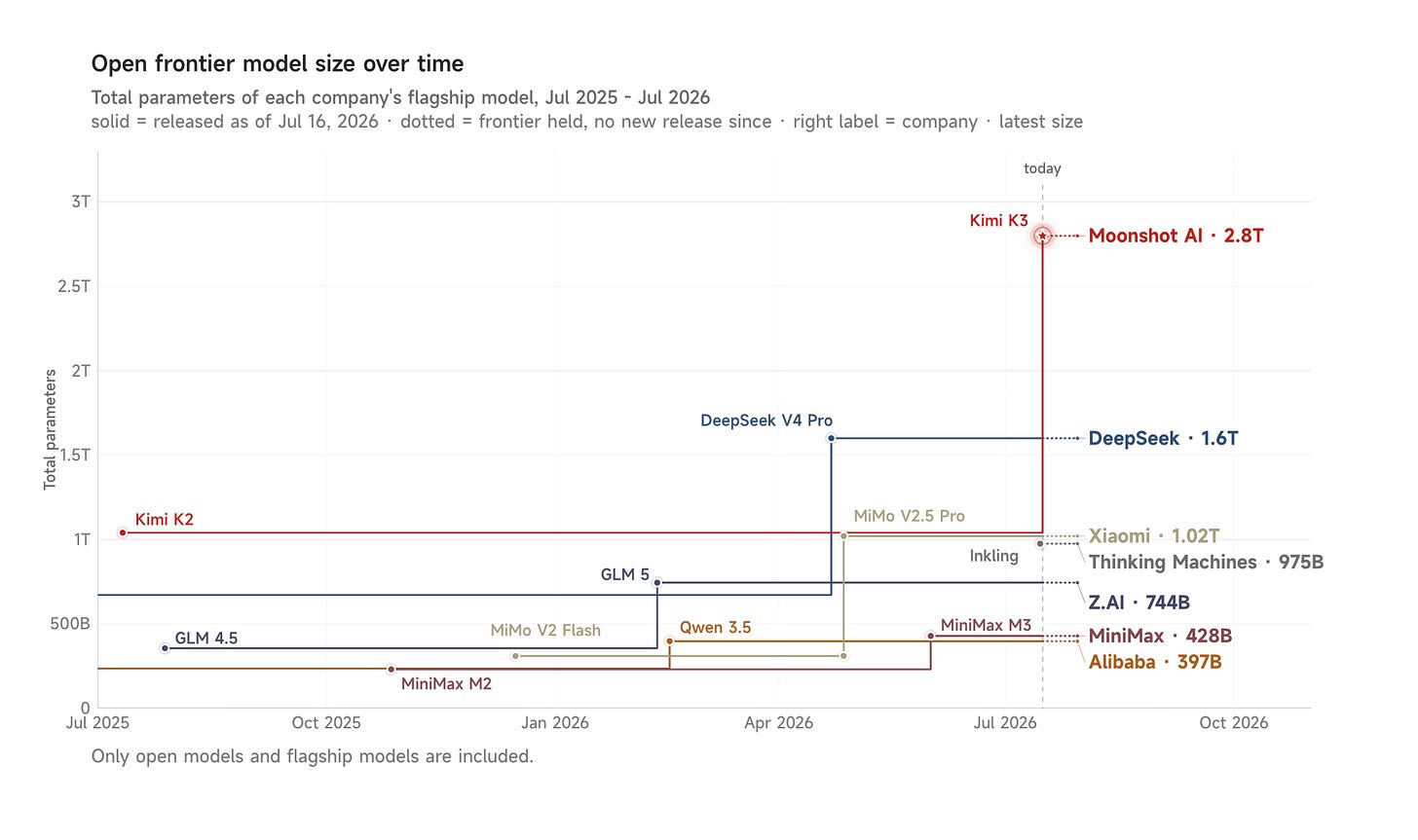
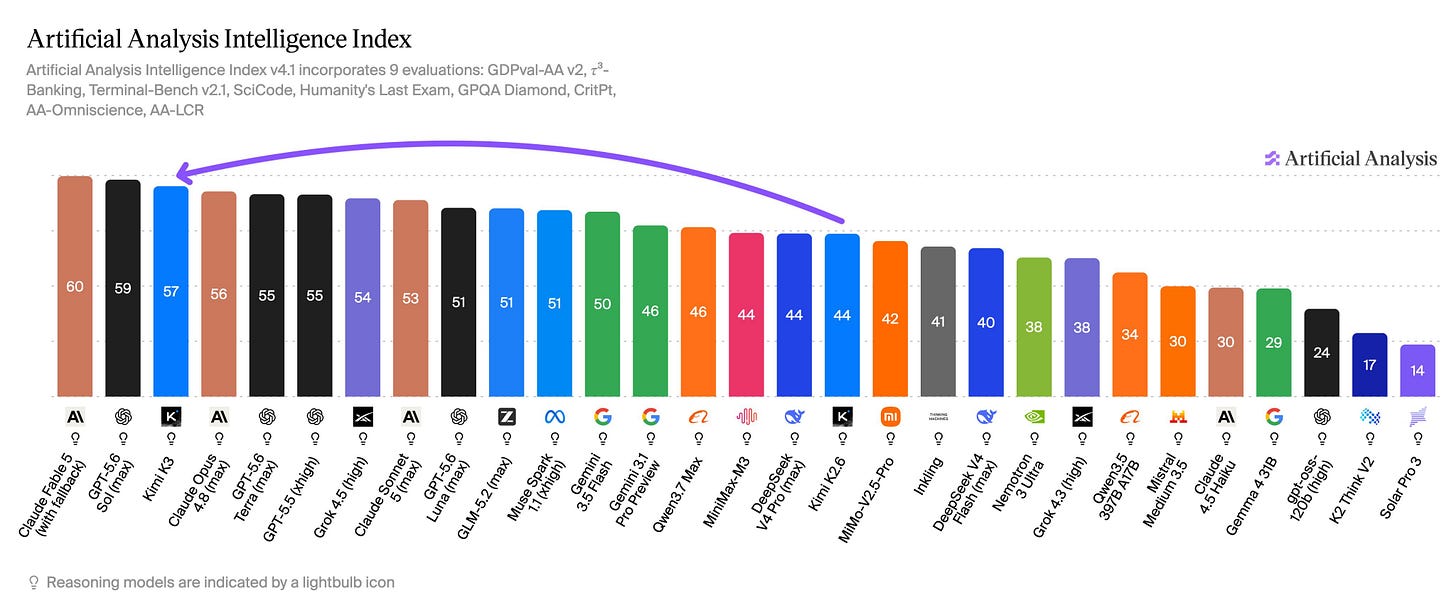
Moonshot AI released Kimi K3, a 2.8-trillion-parameter open-weights model with 104B active parameters, which independent benchmarks show outperforms Claude Opus 4.8 and ranks first among open models on agent benchmarks. The release included supporting infrastructure (FlashKDA kernels, MoE libraries, distributed agent environments) and uses source-available rather than permissive open-source licensing, with commercial restrictions on hosting providers over $20M/year revenue and products over 100M users. Meanwhile, NVIDIA launched an Open Secure AI Alliance arguing that defenders need access to both open and closed models for security, while Anthropic clarified it does not oppose open-weights models but supports chip controls and safety testing instead.
Why it matters
Everyone is writing a lot, but only Kimi K3 shipped today
Also covered by
- The Verge — AI leaders sign statement asking the government to do something about automated AI
- The Verge — AI’s finally expensive enough to make Wall Street nervous
- TechCrunch AI — Anthropic’s Dario Amodei responds: doesn’t oppose open-weight models, but fears Chinese AI
- The New Stack — Anthropic wants tests, not bans, as OpenAI and Google back open weights
- Anthropic News — Our position on open-weights models
- TechCrunch AI — Satya Nadella says companies that trust one AI for everything may not survive
- The New Stack — Microsoft is racing to make OpenAI optional
- TLDR Dev — Open-weight AI is having its Kubernetes moment. Let's not ruin it
- TLDR — AI is Oil, Not God
- NVIDIA — Industry Leaders Unite in Open Secure AI Alliance for AI Safety and Security
- The New Stack — Nvidia, Palantir, Hugging Face join 30 others in race to defend open-weight AI from cyber threats
- The Verge — Nvidia, Microsoft launch open AI security alliance – without OpenAI, Google, or Anthropic
- The New Stack — Microsoft and Google DeepMind agree on AI control — but not on who holds it
- The Neuron — Alphabet's Future Spending Commitments Reached $811B as AI Investment Surged
- The Neuron — NVIDIA, Microsoft, and Meta Tell Washington Not to Lock Down Open AI
- Exponential View — 🔮 Copy that: The curious case of AI distillation #594
- The New Stack — Microsoft, Nvidia, Meta and 22 others defended open weights. Anthropic and OpenAI didn’t sign.
- Sequoia — America’s Open-Model Paradox
- The New Stack — Jensen Huang made his first X post. He used it to lobby Washington about open-weight AI.
- TechCrunch AI — As US weighs response to Chinese AI, industry urges against broad open-weight restrictions
- TLDR Dev — The Arguments Against Open Source AI are Very Bad
- TLDR — Inside China's All-Out Push to Catch Up With American AI Chips
- The Algorithmic Bridge — White House’s Response to China Lacks Confidence in America
- Allen Institute (AI2) — Who gets to understand AI?
- TechCrunch AI — Experts say exploiting Anthropic’s Fable isn’t how Kimi K3 got so good
- TechCrunch AI — Treasury threatens sanctions after White House claims Moonshot distilled Anthropic’s Fable
- The New Stack — Kimi K3: White House alleges Fable 5 siphoning
- TechCrunch AI — Arcee, a US open source AI lab, says Chinese models are not inherently dangerous
- Rest of World — The U.S. wants to contain China’s AI. Silicon Valley keeps using it
- TechCrunch AI — US threatens sanctions against Chinese AI models over IP theft
- The Neuron — Washington Backed Away from Banning Chinese Open AI Models, For Now
- The Verge — America needs to stop getting shocked by Chinese AI
- The Algorithmic Bridge — 7 Consequences of America Finally Losing Its AI Edge to China
- TechCrunch AI — OpenAI is scared of open-weight models. Should the US be?
- MIT Technology Review AI — China’s AI models have Trump’s AI world at war with itself
- Simon Willison — Who’s Afraid of Chinese Models?
- ChinaTalk — China's Mythos Moment
- The Verge — China delivers a one-two punch to America’s AI dominance
- The Algorithmic Bridge — Moonshot is Chinese But Its AI Models Are From Another Planet
- TechCrunch AI — Kimi: Threat or menace?
- Platformer — China has a new top model
- TechCrunch AI — Moonshot’s upcoming Kimi 3 is expected to close the gap with Anthropic’s Opus 4.8