Baidu Launches PaddleOCR-VL: A Breakthrough in Multilingual Document Parsing
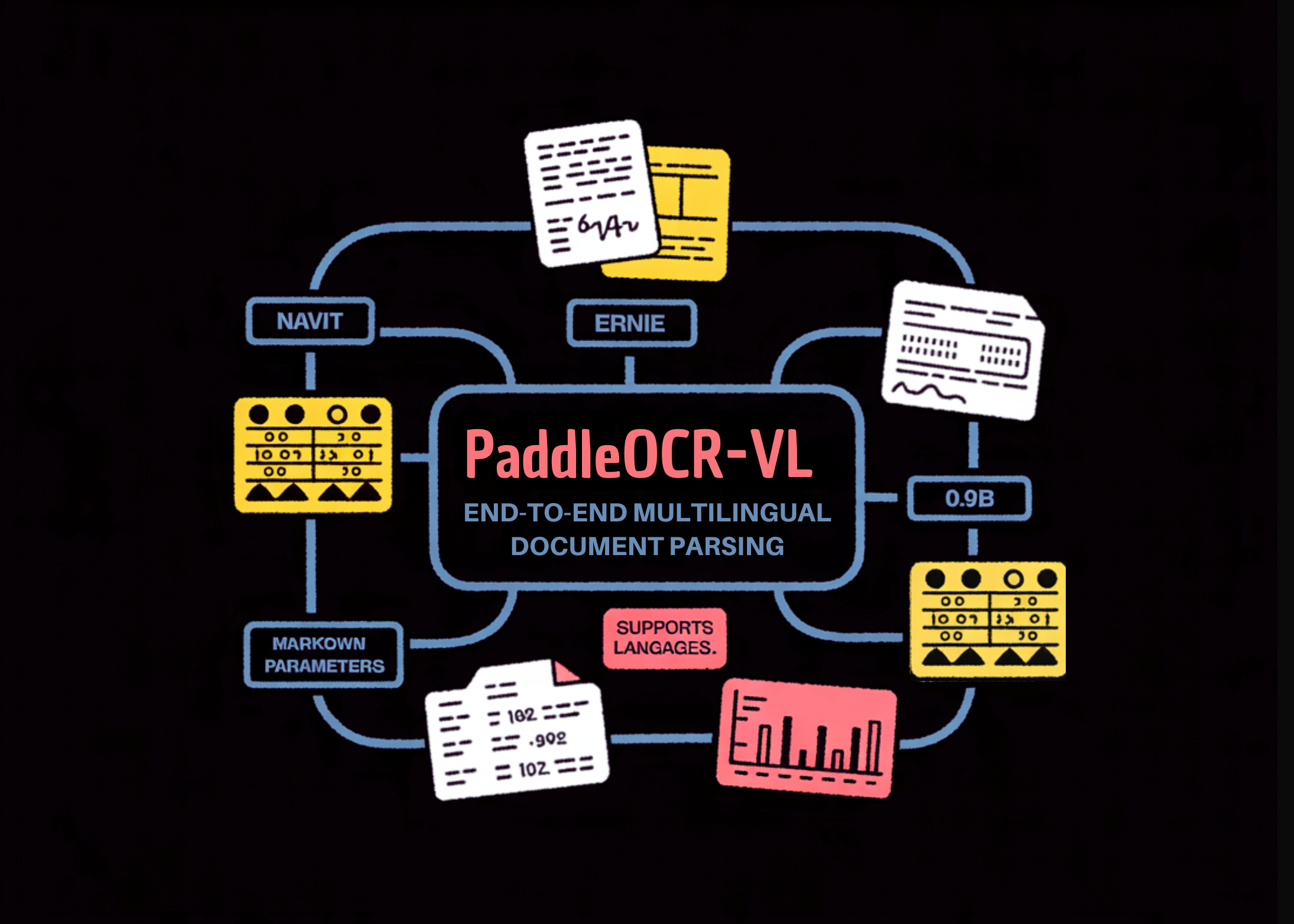
Baidu's PaddlePaddle team has unveiled PaddleOCR-VL, a cutting-edge vision-language model designed for end-to-end multilingual document parsing. This innovative model, featuring 0.9 billion parameters, addresses the challenge of accurately converting complex documents—ranging from dense layouts and small scripts to formulas, charts, and handwriting—into structured Markdown and JSON formats.
Model Architecture
PaddleOCR-VL combines a NaViT-style (Native-resolution Vision Transformer) dynamic-resolution vision encoder with the ERNIE-4.5-0.3B decoder. This architecture not only enhances the model's capability to recognize and parse various document elements but also supports an impressive 109 languages, making it a versatile tool for global applications.
Deployment Pipeline
The deployment of PaddleOCR-VL is structured as a two-stage pipeline:
- Stage One: The PP-DocLayoutV2 module performs page-level layout analysis. Utilizing an RT-DETR detector, it localizes and classifies regions within the document, followed by a pointer network that predicts the reading order.
- Stage Two: The PaddleOCR-VL-0.9B model then conducts element-level recognition based on the detected layout. The final outputs are aggregated into Markdown and JSON, facilitating seamless integration for downstream applications.
This separation of processes is crucial, as it reduces long-sequence decoding latency and improves overall efficiency, making PaddleOCR-VL suitable for real-world deployments.
Significance of the Release
The introduction of PaddleOCR-VL represents a significant advancement in the field of artificial intelligence and document processing. As organizations increasingly rely on digitizing and managing vast amounts of multilingual data, this model is poised to enhance productivity and accuracy in document parsing tasks.
According to the PaddlePaddle team, the capabilities of PaddleOCR-VL will empower businesses to streamline their workflows and improve data accessibility, ultimately leading to better decision-making processes.
Rocket Commentary
Baidu's launch of PaddleOCR-VL represents a significant advancement in document processing technology, particularly in its ability to handle complex layouts and multiple languages. However, as we celebrate this innovation, it is crucial to scrutinize its accessibility and ethical implications. While the model's support for 109 languages is commendable, it must be ensured that such technology does not reinforce existing biases or create barriers for underserved communities. The potential for transforming document parsing in global business is immense, yet it hinges on responsible deployment and a commitment to inclusivity. As the industry progresses, the focus should remain on making AI tools like PaddleOCR-VL not just powerful, but also equitable and user-friendly for all.
Read the Original Article
This summary was created from the original article. Click below to read the full story from the source.
Read Original Article